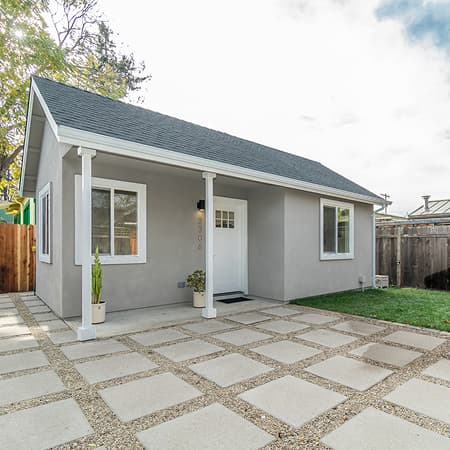
The most common reason NE Florida homeowners look at adding accessory dwelling space is aging parents or adult children. Two paths exist: an attached in-law suite (an addition that includes a kitchenette and full bath) or a detached ADU (a fully separate small dwelling). Florida's 2026 HB 1239 changed some of the rules; HOA covenants are the wildcard.
Here's the comparison.
The two formats
Attached in-law suite. New 400-700 sqft addition attached to the main house, with separate entrance, kitchenette or full kitchen, full bath, bedroom, possibly small living area. Tied into existing HVAC or with mini-split.
Detached ADU. Fully separate dwelling, 500-1000+ sqft, own foundation, own utilities (or sub-metered from main house), own HVAC. Functions as a fully independent residence.
Cost comparison
For a 600 sqft accessory unit:
Attached in-law suite: $130,000 to $220,000 in NE Florida 2026.
Detached ADU: $200,000 to $350,000 for the same square footage.
Detached costs more because it requires its own foundation, separate roof structure, and full utility connection. The attached version shares the existing house's foundation perimeter and roof tie-in, which is meaningfully cheaper per square foot.
Florida HB 1239 (2026) — what changed
Florida House Bill 1239, effective 2026, preempts certain local zoning restrictions on ADUs in single-family residential zones. Key provisions:
1. Single-family zoning preemption. Local zoning that prohibits ADUs in single-family residential districts is preempted by state law. Florida cities and counties cannot ban ADUs outright in these zones.
2. Owner-occupancy rules relaxed. Some local owner-occupancy requirements (the rule that the property owner must live in either the main house or the ADU) are limited under HB 1239.
3. Minimum lot size limits relaxed. Some local minimum lot size requirements for ADUs are preempted.
4. Permit process still applies. The Conditional Use Permit (CUP) and standard building permits are still required. HB 1239 doesn't make ADUs permit-exempt.
5. HOA covenants are NOT preempted. This is the key wildcard. HB 1239 preempts government zoning, not private HOA covenants. If your subdivision's HOA prohibits ADUs in its recorded covenants, that prohibition stands.
HOA covenant reality in NE Florida
Most master-planned NE Florida subdivisions restrict ADUs in their covenants:
- Fleming Island Plantation, Eagle Harbor, Pace Island: Most restrict ADUs.
- Sawgrass, Marsh Landing, TPC Sawgrass: Restrict in most cases.
- Newer Clay County developments: Mixed; verify covenants.
- Older Mandarin and Riverside non-HOA neighborhoods: ADUs generally allowed, subject to standard zoning.
The first verification step on any ADU project is reading the recorded covenants for your specific subdivision. Mark does this on the Day-1 walkthrough.
Permit process comparison
Attached in-law suite:
- Standard residential addition permit
- Mechanical, electrical, plumbing permits as part of the package
- Manual J HVAC recalculation
- Notice of Commencement
- 6 to 10 weeks from clean submission to permit-in-hand
- Total construction: 14 to 22 weeks
Detached ADU:
- Conditional Use Permit through Planning and Zoning (8 to 16 weeks, may require public hearing)
- Then standard residential building permits (additional 6 to 10 weeks)
- Possibly separate utility connection permits
- Notice of Commencement
- Total permit process: 14 to 26 weeks
- Total construction: 20 to 32 weeks
When attached in-law suite is right
Five scenarios where attached makes more sense:
1. HOA prohibits detached ADUs. Most master-planned Clay and St. Johns subdivisions. An attached suite (which doesn't qualify as an ADU under most covenant definitions) often gets approved when a detached one wouldn't.
2. Parent or adult child needs to be in close proximity. Daily check-ins, shared meals, easy emergency response. The attached format keeps everyone under one roof.
3. Budget is constrained. Attached costs $70,000 to $130,000 less than detached for the same square footage.
4. Lot size or shape doesn't accommodate detached. Smaller lots, awkward yard layouts, mature trees that can't be removed.
5. Resale strategy values addition over separate unit. Some markets value a large primary house over the same total square footage split between two structures.
When detached ADU is right
Five scenarios where detached makes more sense:
1. Tenant rental income. A detached unit with separate entrance, separate utilities, and acoustic separation rents better and generates higher per-month rent than an attached suite.
2. Adult child wants real independence. Separate front door, separate utilities, separate everything. Reads as their own place rather than living at parents'.
3. Parent prefers private space. Some elderly parents want their own quiet, separate dwelling rather than attached living.
4. Future flexibility matters. A detached ADU can be a guest house, then a rental, then an in-law suite, then a home office, then a guest house again. An attached suite is more permanent in its function.
5. Resale strategy values multi-unit property. Some buyers (especially in Mandarin, Riverside, San Marco) specifically seek properties with separate income units.
What's not in the cost ranges (both formats)
Four common additional costs:
- Impact fees ($4,000 to $10,000)
- Utility connections / sub-metering ($2,000 to $8,000)
- HOA application fees and legal coordination ($500 to $3,000)
- Public hearing legal coordination if required ($1,500 to $5,000 for detached ADUs)
The lot constraint check
Before scope on either format, three lot-level checks:
1. Setback requirements. Detached ADUs typically need 5-15 foot side and rear setbacks; attached additions follow normal addition setback rules.
2. Lot coverage limits. Total impervious surface on the lot has a code maximum. Adding either format counts toward the limit.
3. Septic capacity (where applicable). If the property is on septic instead of sewer, the existing system may not support the additional fixture count. Tank upgrade or full septic replacement: $5,000 to $25,000.
Related reading
- ADU Cost & Permits in Clay County, FL — full guide with cost tiers and permit walkthrough
- Florida ADU Rules 2026: What Changed — HB 1239 deep dive
- Master Suite Addition: Cost and Process for NE Florida Homes — addition format alternative
- Home Additions — Tivey Construction — what's included
Ready when you are.
Tell me about your project — you'll see your real budget range mid-flow, and I'll call within 24 hours. No spam, no call center, just me.