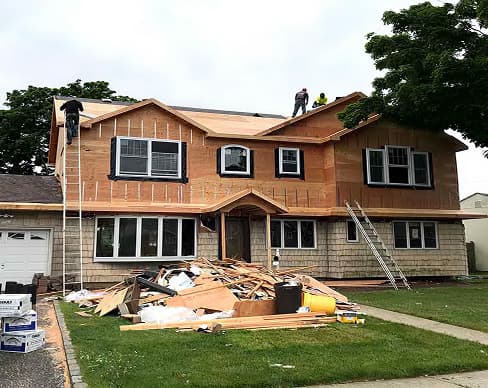
The most visible part of any room addition is the roof. A roof that ties cleanly into the existing roofline reads as part of the original house; a poor tie-in reads as bolted on. The cost difference between the two is meaningful — and the right approach depends on which existing roof you're tying into.
The three approaches
Gable extension. Extend the existing gable end outward, keeping the same roof pitch. Visually the cleanest tie-in for a house with a clear gable orientation. The new addition appears to be a continuation of the original.
Hip extension. Extend the existing hip roofline. Works for ranch-style houses with hip roofs (most common for 1960s-80s NE Florida builds). The hip continues onto the addition, maintaining the original geometry.
Shed roof / lower addition. Lower-pitch shed roof attached below the existing eave. The addition is visually subordinate to the original house. Cheapest option but reads as an addition rather than as integrated.
What works on which house
Florida Cracker / coastal cottage style: Gable extension almost always. The single dominant gable defines these houses, and a clean gable extension preserves the architectural character.
1960s-80s ranch: Hip extension. Most NE Florida ranches have hip roofs, and a hip-extension addition reads as natural.
Newer 1990s-2010s subdivision homes: Mixed. Most have hip roofs but with multiple gables and dormers. The right approach depends on which roof element the addition extends.
1990s-2000s Florida traditional: Gable extension if the addition is on a gable side; hip extension if on a hip side.
Spanish Mediterranean: More complex. Tile roofs, multiple roof planes, and stucco walls all need careful matching. Often the right answer is a fully-engineered roof design rather than a generic extension.
Two-story homes: Special case. A single-story addition to a two-story house can use any of the three approaches; the choice depends on visibility from key sight lines.
Cost differences
For a 400 sqft single-story addition in NE Florida:
Gable extension: $20,000 to $35,000 in roof cost (framing, sheathing, underlayment, shingles or other roofing material, flashing, soffit, fascia).
Hip extension: $25,000 to $42,000. Slightly more complex framing than gable; additional rafter cuts and ridge details.
Shed roof: $12,000 to $22,000. Cheapest option; simplest framing.
The cost difference between gable/hip and shed is roughly $8,000 to $20,000. Most homeowners pay it because the appearance difference is significant.
What "matching the existing roof" actually requires
Four matching elements that have to align:
1. Pitch. The slope of the new roof must match the existing within reasonable tolerance. A 4:12 pitch addition on a 6:12 pitch house creates an awkward visible step. Standard practice is exact pitch match.
2. Material. Same shingle brand, color, and weight. Manufacturers update product lines every few years; an older house with discontinued shingles often needs partial re-roof of the original section to match the new addition.
3. Eave detail. Soffit material, fascia profile, gutter spec all visible from grade. Mismatch reads as obvious.
4. Ridge height. The new ridge has to hit the existing ridge cleanly (for gable extensions) or extend the existing hip line (for hip extensions). Geometric design needs to be exact.
When partial re-roof of the original is necessary
Three scenarios where the addition project needs to include re-roofing part or all of the existing house:
1. Existing shingles are discontinued. Most asphalt shingle product lines are updated every 5-10 years. Older shingles can't be matched exactly with current products. The visible mismatch on a partial roof is usually unacceptable for a quality install.
2. Existing roof is at end of life. A 20-year roof that has 2 years left vs. a new addition with a 25-year roof creates an awkward situation in 5 years. Better to re-roof the original at the same time.
3. The tie-in geometry requires it. Some addition designs (especially complex hip extensions) require modifying the existing roof structure in a way that effectively requires re-roofing the affected section.
A partial re-roof typically adds $5,000 to $20,000 to the addition cost; a full re-roof adds $15,000 to $45,000.
What inspection checks
Clay County, Duval County, and St. Johns County roof framing inspections check:
- Connection details between new and existing rafters
- Hurricane strap placement (FBC requires straps at every rafter-to-wall connection)
- Sheathing nail spacing
- Flashing detail at the new-to-existing roof intersection (this is the critical leak point if not done right)
The flashing detail is the highest-risk failure mode. A poor flashing job at the addition tie-in is a slow leak waiting to happen — water sees damage 2 to 5 years after the addition is complete, and the source is the inspection-stage detail nobody verified properly.
Mark's standard approach uses ice-and-water shield extending 24 inches up both the new and existing roof slopes at the tie-in, plus a step-flashing system that integrates with the existing siding or stucco. This is more material than code minimum requires; it's the cheapest insurance line item on the addition.
What about flat-roof additions?
Some modern designs call for flat-roof additions. NE Florida's high rainfall makes these higher-risk than pitched roofs:
- Drainage slope must be exact (1/4 inch per foot minimum)
- Membrane material spec matters more (TPO, EPDM, modified bitumen all have different lifespans in NE FL UV)
- Tie-in to the existing pitched roof requires careful flashing detail
Flat-roof additions cost about the same as pitched-roof additions but have shorter membrane lifespan (15-25 years vs. 25-40 for shingles). Mark generally recommends pitched roofs unless the architectural vision requires flat.
Related reading
- Home Addition Cost Per Square Foot in Jacksonville, FL — pricing context
- Home Addition Foundation Options for Florida Flood Zones — foundation companion piece
- Home Addition Cost & Permits in Clay County, FL — full guide
- Home Additions — Tivey Construction — what's included
Ready when you are.
Tell me about your project — you'll see your real budget range mid-flow, and I'll call within 24 hours. No spam, no call center, just me.