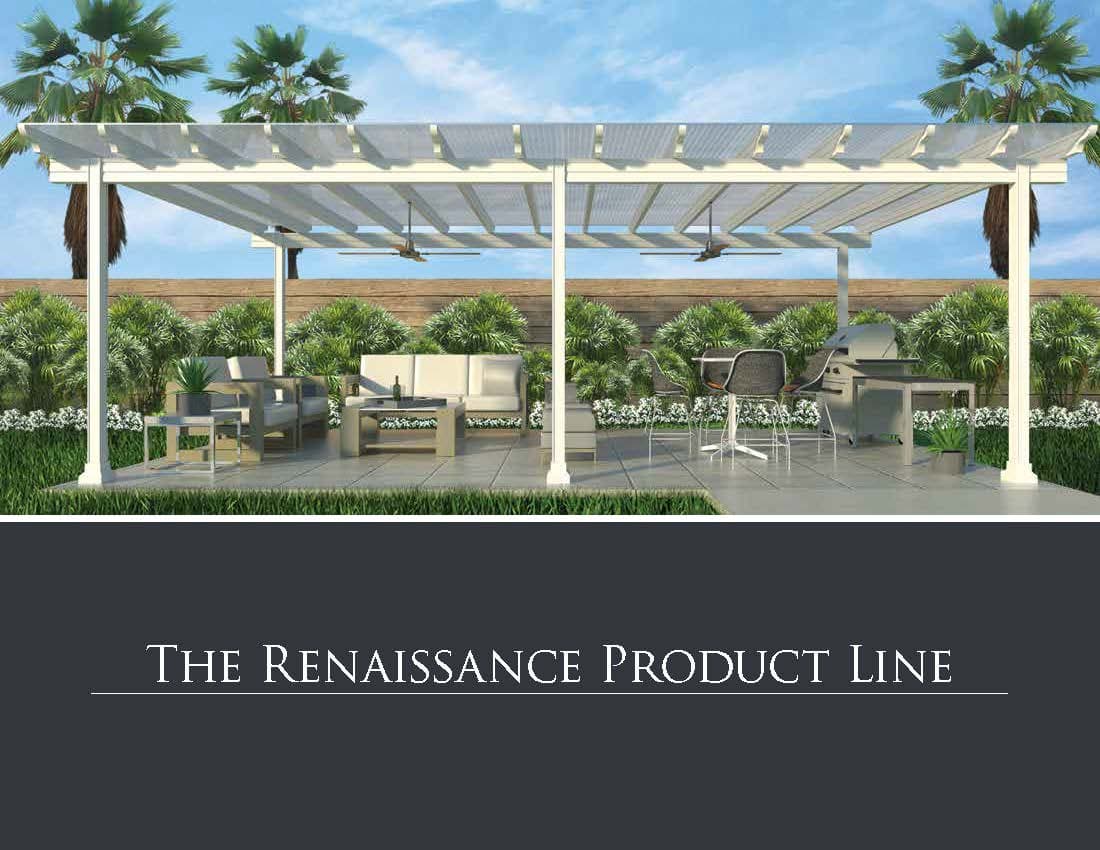
Renaissance Patio's Dolce screen room is the premium-tier offering in their lineup — heavier framing, hidden fasteners, premium mesh and hardware standard, and a finished aesthetic that reads as architecture rather than an aluminum frame. It costs 30 to 50% more than a standard Renaissance enclosure. Here's exactly what that buys you.
What's the same
Both Dolce and standard Renaissance enclosures share:
- Lifetime warranty on the structural frame
- 175 mph hurricane rating (NEFBA-published spec)
- Documented engineering on file with NE Florida county building divisions
- Same permit-pull process via Tivey's CGC1511598
- Same install crew and project management
The premium isn't about engineering or warranty. It's about the experience inside the room.
What the Dolce premium actually buys
Five differences that justify the cost premium for the right project:
1. Hidden fasteners and clean exterior lines. Standard Renaissance enclosures have visible fasteners on the exterior aluminum. Dolce uses a different connection system that hides fasteners inside the framing. The visual difference is significant — Dolce reads as architectural, standard reads as utilitarian.
2. Heavier-gauge aluminum framing. Dolce uses thicker aluminum extrusions throughout. The frame feels more substantial, holds up better to incidental impact (kids, pets, furniture), and provides additional safety margin above the already-conservative 175 mph wind rating.
3. Premium mesh standard. No-see-um mesh comes standard on Dolce instead of as an upgrade. For NE Florida, this matters — biting midges (no-see-ums) are unpleasant in summer, and standard fiberglass mesh doesn't stop them.
4. Stainless hardware standard. All exposed hardware is stainless steel by default. On standard enclosures this is an upgrade. For coastal installs (Ponte Vedra, Jacksonville Beach), stainless is mandatory; on inland installs, it's a longevity upgrade that's just included with Dolce.
5. Finished interior aesthetic. Dolce's interior framing has a finished look that doesn't require additional ceiling treatment or trim work to look complete. Standard enclosures often need ceiling treatments, trim wraps, or additional finish work to look polished.
Cost difference in real numbers
For a 16×20 screen room:
- Standard Renaissance with no-see-um mesh upgrade: $16,000 to $20,000
- Dolce with all premium standard: $22,000 to $30,000
Premium of $6,000 to $10,000 over a standard install with no-see-um mesh upgraded.
The premium narrows when you compare apples to apples. A standard Renaissance with all upgrades — no-see-um mesh, stainless hardware, premium roof, finished interior trim — runs $19,000 to $25,000. Against that, Dolce is $3,000 to $5,000 more, not the apparent $6,000 to $10,000.
When Dolce is worth it
Three scenarios where Dolce makes sense:
1. The screen room is a primary outdoor entertaining space. If the room is the focal point of how you use the backyard — daily morning coffee, evening drinks, dinner parties — the architectural aesthetic of Dolce justifies itself. You see the framing every time you use the room.
2. High-end or large-investment property. Ponte Vedra primary residences, premium Mandarin or San Marco homes, anywhere the rest of the home is finished to a high standard. A standard utility-grade enclosure on a $1.5M house reads as out of place.
3. The screen room is visible from key sight lines. If the enclosure is visible from the main living area, the kitchen, or the front of the house, the appearance matters more than if it's tucked behind a privacy fence.
When standard is the right call
Two scenarios where standard Renaissance is the better choice:
1. Pure functional enclosure for a pool or backyard use case. If the goal is mosquito control around a pool, or covering a back patio that doesn't get used as primary living space, standard Renaissance gives you the same warranty, same wind rating, and same engineering at lower cost.
2. Budget-constrained primary-residence install. If the budget supports a standard enclosure but not Dolce, the standard install is still substantively better than any DIY or off-the-shelf alternative. Don't skip the project to save up for Dolce — the standard option is excellent on its own.
What you can't tell from the brochure
Three things Mark consistently flags during the Day-1 walkthrough that the brochure photos don't communicate:
1. The wall-attachment detail. Dolce hides the wall attachment in a way that looks cleaner. Standard has a visible attachment plate. From inside the room, both look similar; from outside, the difference is noticeable.
2. The corner detail. Dolce uses a different corner connection that's stronger and visually cleaner. Standard corners are still strong but show the connection plate.
3. The post-to-deck connection. Both systems use hurricane-rated post anchors. Dolce hides them under a finish trim cover; standard leaves them visible. From a distance both look the same; up close, the difference is visible.
Permit and install timeline
Same as standard Renaissance. Permit time runs 3 to 6 weeks at Clay County or City of Jacksonville. Install runs 1 to 3 weeks for a standard-size project.
Resale consideration
A Dolce enclosure adds appraised value at a similar percentage of cost as standard Renaissance — both are permitted, engineered, warranty-backed installations. The aesthetic premium of Dolce shows up in market presentation more than in appraised value. For homes priced above $700,000 in NE Florida, the Dolce aesthetic supports the listing price; for entry-level homes, standard is more proportionate.
Related reading
- Renaissance Patio vs DIY Patio Cover Comparison — engineering trade-offs
- Screen Room Cost in Jacksonville, FL: 2026 Pricing Guide — pricing by tier
- Renaissance Patios & Sunrooms — Tivey Construction — what's included in a Tivey install
Ready when you are.
Tell me about your project — you'll see your real budget range mid-flow, and I'll call within 24 hours. No spam, no call center, just me.