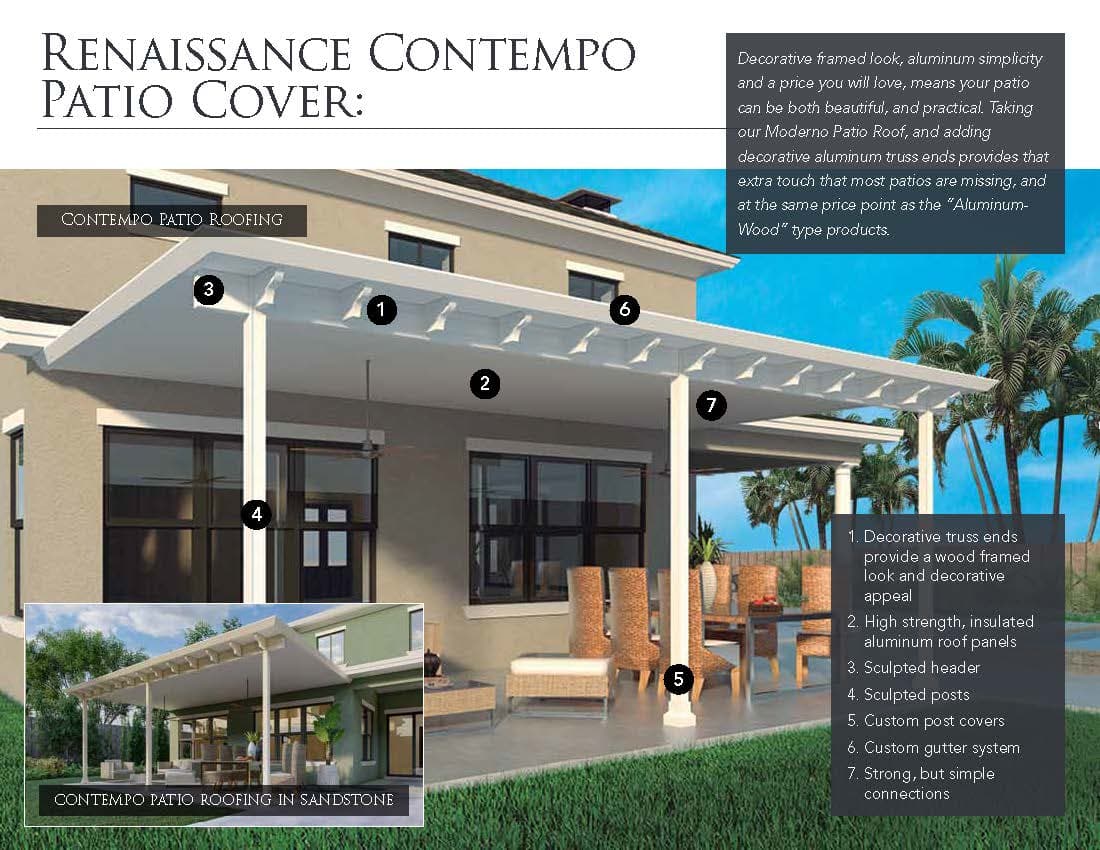
Most NE Florida patio cover decisions come down to one of two paths: a Renaissance Patio install via a licensed contractor like Tivey, or a DIY off-the-shelf cover the homeowner buys at a big-box store and assembles or hires a handyman to assemble. The cost difference is real, but the comparison isn't as simple as "Renaissance is more expensive."
The two systems
Renaissance Patio. A NEFBA-affiliated engineered cover system with a lifetime warranty on structural components and a 175 mph hurricane rating. Sold through and installed by licensed contractors. Documented engineering on file with Clay County, Duval County, and St. Johns County for permit submission.
DIY off-the-shelf cover. Aluminum or polycarbonate cover sold by Lowe's, Home Depot, or specialty retailers. Self-engineered or generically engineered. Warranties typically 5 to 10 years. Sold to homeowners who self-install or hire a handyman.
Cost comparison
For a 16×20 patio cover (a common NE Florida size):
Renaissance Patio installed by Tivey: $14,000 to $24,000 depending on roof type (aluminum-pan vs. polycarbonate vs. Hi-Lite), wall conditions, and any electrical for fans or lights.
DIY off-the-shelf: $3,000 to $6,000 in materials, plus $1,500 to $4,000 if a handyman assembles it. Total $4,500 to $10,000.
Apparent savings on the DIY: $5,000 to $20,000.
What the savings actually buy you
The DIY path comes with tradeoffs that don't appear in the price comparison:
Permit risk. Most off-the-shelf covers come with generic engineering that may or may not meet Clay County's 130 mph (or coastal Ponte Vedra's 140 mph) wind-load requirement. Permit reviewers can require custom engineering after the fact, adding $1,500 to $4,000 in delay and engineering cost.
Insurance risk. A DIY cover that fails in a storm and damages the home (or worse, a neighbor's) is your liability. Most homeowner's insurance won't cover damage from non-permitted or improperly-engineered structures. The deductible alone can exceed the savings on the cover.
Warranty risk. Off-the-shelf manufacturer warranties typically void if the cover wasn't installed per spec. Self-install void rates run high. A 5-year cover that's voided becomes a no-warranty cover.
Install quality. A DIY install that uses incorrect anchoring, wrong fastener spacing, or non-rated hardware can fail in 80 mph wind. Florida sees 80+ mph storms multiple times per year.
What Renaissance buys you
Lifetime structural warranty. The frame, posts, and beams are covered for as long as you own the house. The screen mesh and finish work has its own coverage tier.
175 mph wind rating. Engineered to exceed the FBC requirement for any Florida county. In Clay (130 mph code) or Duval (130 mph) or coastal St. Johns (140 mph), Renaissance has a 30 to 45 mph margin above code.
Documented engineering. Renaissance's engineering is on file at all NE Florida county building divisions. Permit review is faster because the structural calculations don't need re-review for each install.
Code-current install. Tivey's installs include hurricane-rated post anchors, current cable bracing standards, and stainless hardware where coastal exposure requires it.
One contract, one warranty path. When something is wrong 5 years from now, you call one number — Tivey. With a DIY install, the homeowner is the integrator and the contact for every manufacturer.
The handyman alternative
Some homeowners hire a local handyman to install an off-the-shelf cover. This is the worst of both options:
- The handyman isn't a licensed contractor, so the work can't be permitted under their license.
- The cover isn't engineered for NE Florida wind code, so it can't be permitted under any license.
- The handyman's general liability (if any) doesn't cover the structure.
The handyman path produces an unpermitted, uninsurable cover that becomes the homeowner's full liability if it fails. Cost savings are real until something goes wrong.
When DIY actually makes sense
Two scenarios where the DIY off-the-shelf path is reasonable:
1. A non-attached cover in the middle of the yard. A freestanding pergola or shade structure that doesn't attach to the house has lower wind-load requirements and less permit complexity. Some are even permit-exempt depending on size and county.
2. A pure shade structure with no roof. A trellis or open-lattice cover that doesn't shed water or block wind has lower engineering requirements than a solid-roof cover. Still typically needs a permit, but easier engineering.
For anything attached to the house with a solid or polycarbonate roof, Renaissance (or an equivalent engineered system) is the right call.
Permit timeline difference
Renaissance permit submission to Clay County: 3 to 5 weeks for permit issuance because the engineering is on file.
DIY off-the-shelf permit submission: 5 to 10 weeks if the engineering needs review, plus possible re-submission cycles if the engineering doesn't meet code. Realistic total: 8 to 14 weeks plus engineering cost.
Resale and appraisal value
A permitted Renaissance cover with documented engineering adds appraised value at roughly 50 to 70% of install cost. A DIY off-the-shelf cover adds 0 to 30% of install cost — appraisers and buyers know the difference.
For a homeowner planning to be in the house long-term, the resale math matters less. For one planning to sell within 5 to 10 years, the appraisal difference partially offsets the upfront cost difference between Renaissance and DIY.
Related reading
- Patio Cover Types in Northeast Florida — companion piece on cover material choices
- Hurricane-Rated Patio Cover Spec in Florida — wind-load engineering detail
- Sunroom Cost & Permits in Clay County, FL — full guide
- Renaissance Patios & Sunrooms — Tivey Construction — what's included in a Tivey Renaissance install
Ready when you are.
Tell me about your project — you'll see your real budget range mid-flow, and I'll call within 24 hours. No spam, no call center, just me.