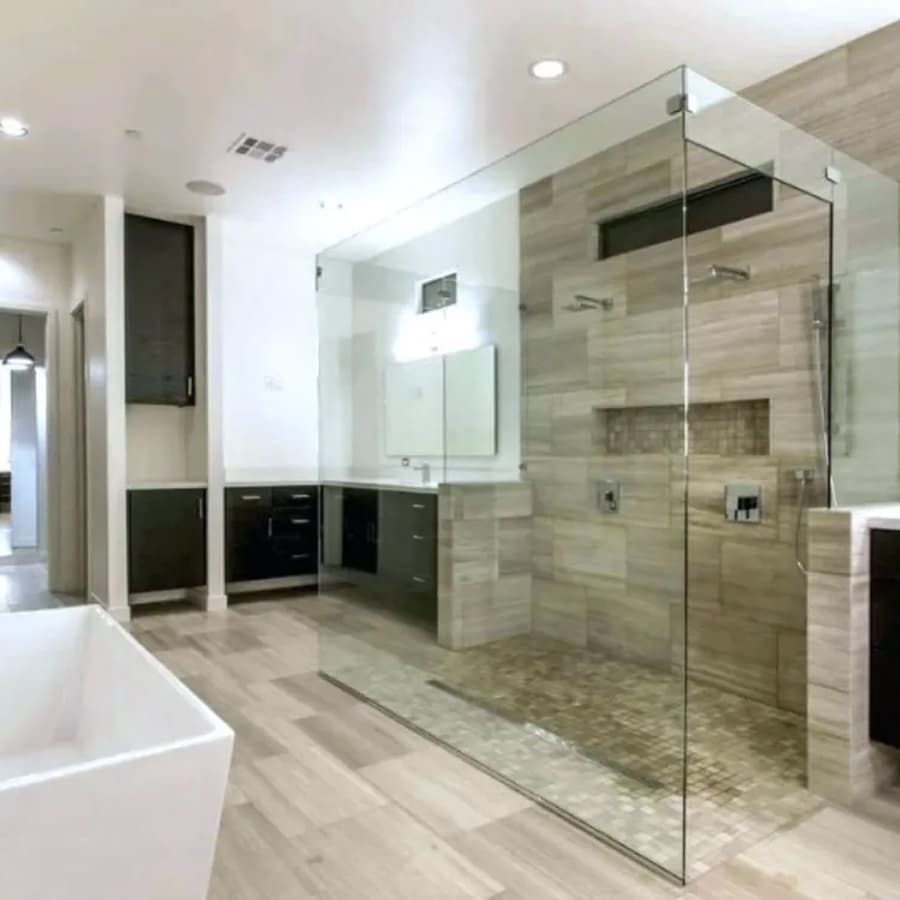
NE Florida humidity is unforgiving on bathroom tile. A tile installation that works fine in Phoenix or Denver can fail in Jacksonville within a decade if the substrate, waterproofing, or grout selection doesn't account for the climate.
These are the five mistakes Mark sees most often when rebuilding a bathroom in a 1990s or 2000s NE Florida home — and what the right install looks like instead.
Mistake 1: Green board behind the tile
Green board is moisture-resistant drywall. It was code-compliant for tile substrate in wet areas through the early 1990s. It is not now, and it never worked well in NE Florida humidity.
The failure pattern is consistent: water vapor passes through the grout (which is porous, not waterproof), reaches the green board, and gradually breaks down the gypsum core. The tile stays put for years, then suddenly the entire shower wall comes off in one piece when someone leans against it.
The right install: Cement backer (HardieBacker or DurockNextGen) over the studs, then a waterproofing layer (Schluter Kerdi membrane, RedGard liquid, or equivalent), then thinset and tile. The cement backer doesn't degrade in moisture; the waterproofing layer keeps water out of the wall cavity entirely.
The cost difference vs. green board: about $300 to $600 on a typical shower surround. The lifetime difference: the green-board install fails in 8 to 12 years; the cement-backer-plus-waterproofing install fails when the building is demolished.
Mistake 2: Skipping the waterproofing layer over the cement backer
A meaningful share of NE Florida tile installs use cement backer (correct) but skip the waterproofing layer over it (incorrect). The thinking is that cement backer doesn't degrade in moisture, so a separate waterproofing layer isn't needed.
This is wrong. Cement backer doesn't degrade, but it's also not waterproof. Water passes through it freely, into the wall cavity, where it finds wood framing, insulation, and drywall behind the shower — all of which do degrade.
The right install: Always include a waterproofing layer between the backer board and the tile. The most common systems in NE Florida are Schluter Kerdi (sheet membrane) and RedGard (paint-on liquid). Both work. Schluter is more forgiving for inexperienced installers; RedGard requires more careful application but costs less.
Mistake 3: Sanded grout in a shower with porcelain tile
Sanded grout is for joints wider than 1/8 inch. Unsanded is for narrower joints. Most modern porcelain bathroom tile has joints in the 1/16 to 1/8 inch range, which technically qualifies for either — but sanded grout in a tight joint with porcelain tile is harder to apply correctly, more likely to crack, and looks worse.
The bigger issue: standard cement-based grout is porous. It absorbs water, holds moisture, and grows mold over time even when properly sealed. A typical NE Florida shower with cement-based grout requires resealing every 12 to 18 months to stay clean.
The right install: Epoxy grout in showers and other wet areas. Epoxy grout is non-porous, doesn't absorb water, doesn't grow mold, and never needs resealing. Higher upfront cost (about 3× cement grout) and harder to apply, but the lifetime maintenance difference is substantial.
For floors and dry areas, cement grout with a high-quality penetrating sealer applied at install and re-applied every 2 to 3 years is fine.
Mistake 4: Wrong tile substrate on slab floors
NE Florida bathrooms are usually on slab. Slab tile installations have their own failure modes if the substrate isn't right.
Two common mistakes:
No uncoupling membrane. The slab and the tile expand at different rates as humidity and temperature change. Without an uncoupling membrane (Schluter Ditra is the most common), tile installed directly to the slab can crack along the grout joints over time, especially with large-format tile.
No vapor barrier on a slab without one. Older NE Florida slabs (pre-2000) often weren't poured with a vapor barrier underneath. Floor tile installed directly on a slab without a vapor barrier will telegraph efflorescence (white mineral deposits) within a year or two as moisture wicks up through the slab.
The right install: Test the slab for moisture (calcium chloride test or relative humidity probe). If the slab is dry, install Schluter Ditra or equivalent uncoupling membrane, then thinset and tile. If the slab tests wet, use a vapor-mitigating self-leveling underlayment first.
Mistake 5: Tile installed before the bathroom is properly ventilated
This isn't a tile installation mistake exactly — it's a bathroom design mistake that becomes a tile failure within a few years.
NE Florida humidity inside a bathroom can run 70 to 85% during and after a shower. If the vent fan is undersized (Florida code minimum 50 CFM is undersized for a master bath), or if it's vented into the attic instead of the exterior, that humidity stays in the bathroom and condenses on cool surfaces — including the back side of the tile and the grout.
Over time, the trapped moisture promotes grout staining, sealant degradation, and mold growth in places nobody can see.
The right install: 110 CFM minimum vent fan on a master bath, with a humidistat (not a timer), vented to the exterior. Vent fan termination must come out through the roof or a wall, never into the attic.
What inspection catches and what it doesn't
The Clay County and Duval County rough-in inspections catch the obvious failures — missing waterproofing, wrong fixture rough-in, vent fan termination location. They don't catch grout selection, tile-to-substrate compatibility, or installation technique.
That's why the contractor matters more than the inspection. Mark's tile work uses cement backer plus Schluter or RedGard waterproofing as standard, epoxy grout in wet areas, and Ditra uncoupling on slab installations. None of those are required by code; all of them dramatically extend the bathroom's useful life.
Related reading
- Bathroom Remodel Cost & Permits in Clay County, FL — guide with permit walkthrough
- Bathroom Remodeling — Tivey Construction — what's included in a Tivey project
- Walk-In Shower vs. Tub: Aging-in-Place Decisions for NE Florida Homes — companion cluster post
Ready when you are.
Tell me about your project — you'll see your real budget range mid-flow, and I'll call within 24 hours. No spam, no call center, just me.