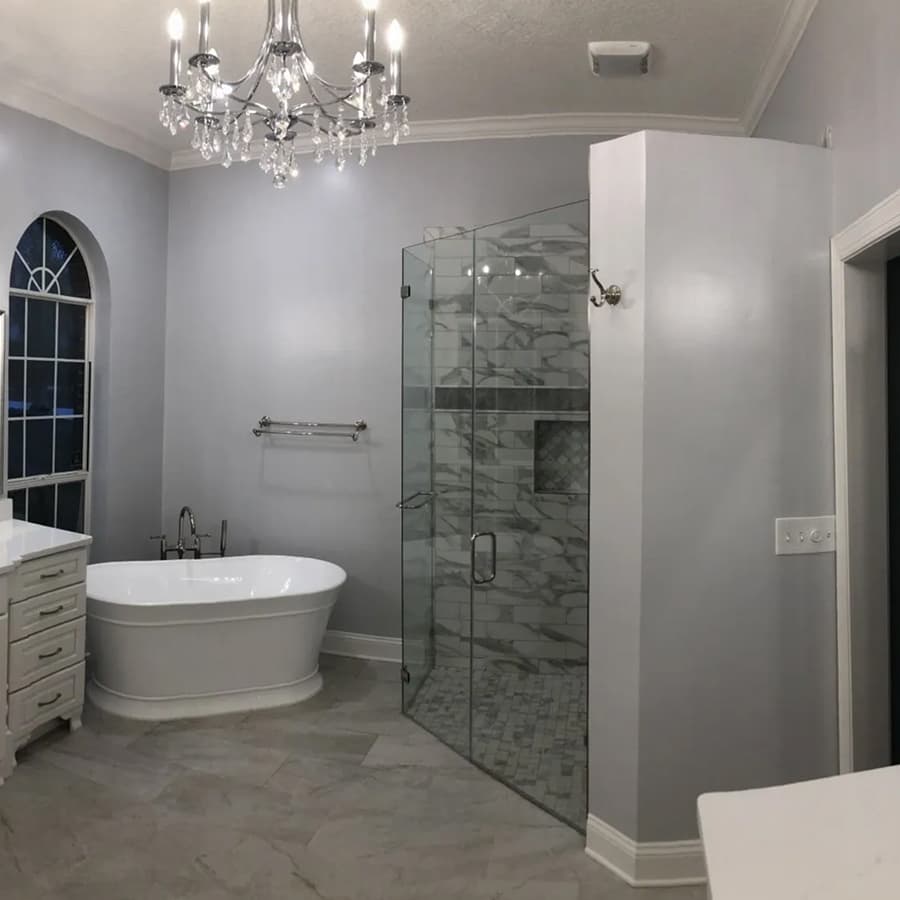
Aging-in-place bathroom modifications break into two categories — the ones that actually help, and the ones that look accessible without being. Mark scopes both kinds in NE Florida, and the difference becomes more important as the household ages.
This is the working list of what's worth including in a primary-bath remodel for a household that plans to stay in the home through retirement.
Curbless shower entry
The single most consequential aging-in-place modification. A curb — even a 4-inch one — is a fall risk that gets larger every decade past 60. Curbless removes it entirely.
Two ways to execute it:
Linear drain at the wall. The shower floor slopes in one direction toward a long drain at the back wall. Easier to walk on (the slope is gentle and consistent), aesthetically cleaner, and the most common premium spec. Adds $400 to $700 over a center drain.
Center drain with four-way slope. Cheaper but harder to walk on with reduced balance. Each direction has a different slope; the foot lands on a different angle depending on stride.
Either way, the slab work is the cost driver. On a slab-on-grade NE Florida home, the existing floor has to be cored or cut to set the drain, and the bathroom floor outside the shower has to be reset to match. Adds 1 to 2 weeks to the timeline and $5,000 to $10,000 to the project cost.
Grab bars (or blocking for them)
Grab bars are the most-installed accessibility item and the easiest to do wrong.
The right execution requires solid blocking (1x6 or 2x6 plywood backer) behind the wallboard at three locations: the shower entry wall, the side wall, and the back wall. Each location holds a grab bar properly anchored to the framing — typically 250+ pounds of pull-out load.
Surface-mount anchors that promise to hold grab bars without blocking are mostly fiction. They work on standard drywall up to maybe 50 pounds; a real fall load (300+ pounds) pulls them out. Anyone who's actually fallen onto a grab bar knows this immediately.
The right time to install blocking is during the bathroom remodel, regardless of whether grab bars get installed now. Adds about $200 in framing time. Without blocking, retrofitting grab bars later requires either opening the tile or accepting the surface-mount limitation.
Mark spec's blocking on every primary bath remodel for a household with anyone over 55 or planning to stay in the house long-term.
Comfort-height (ADA-height) toilets
Standard toilet seat height is 14 to 15 inches from the floor. Comfort-height (also called "right-height" or "ADA-height") is 17 to 19 inches.
The taller seat is dramatically easier to use for anyone with knee, hip, or back issues — and most homeowners over 60 prefer it once they've used one. The cost difference is zero to $100 at the equipment level. Manufacturers stock both heights at the same price point in most lines.
The exception: families with young children sometimes prefer standard height. For a household where multiple users are very young, a step-stool plus a standard toilet works better than a comfort-height toilet.
Anti-scald (thermostatic) shower valve
Florida code requires pressure-balanced shower valves in any new shower. Anti-scald (thermostatic) goes one step further by holding the water temperature constant when someone flushes a toilet or runs another fixture.
The reason this matters for accessibility: a flush of cold water triggers a startle reflex. The startle reflex causes a slip. The slip causes a fall. Anti-scald valves prevent the temperature surge that triggers the reflex.
Cost difference: $200 to $400 over a basic pressure-balanced valve. Mark spec's anti-scald on any primary bath remodel for older households.
Walk-in tub vs. walk-in shower
Walk-in tubs are heavily marketed for accessibility but are usually the wrong call.
The pros: lets the user sit while bathing, avoids the slip risk of stepping over a tub edge.
The cons: requires the user to enter the tub before it fills (the door has to be closed and sealed before water can be added) and to wait until it drains before exiting. A typical walk-in tub fill is 8 to 12 minutes; the drain is 4 to 6 minutes. Total bath time is 25 to 40 minutes longer than a normal bath.
The bigger issue: walk-in tubs are tubs. They preserve the slip-and-fall risk of a wet floor entry, the difficulty of stepping over the door threshold, and the cleaning burden. They cost $3,000 to $8,000 for the tub alone, plus install.
A walk-in shower with a curbless entry, a fold-down bench, and a handheld shower head is almost always the better aging-in-place spec at similar or lower cost.
Lighting that helps vs. lighting that doesn't
Three lighting upgrades make a meaningful difference for older eyes:
Higher ambient light levels. Bathrooms typically come in around 50 lumens per square foot from builder-grade lighting. Aging eyes benefit from 100+ lumens per square foot. Add fixtures or upgrade bulbs to get there.
Color temperature in the 2700–3000K range. Cool white (4000K+) is harsh on aging eyes; warm white (2700–3000K) is easier. Specifically: warm color temperature reduces glare and improves contrast.
Motion-activated nightlight at floor level. Small, low-output, automatic. Eliminates the fall risk of navigating a dark bathroom at 3 AM. Costs $30 to $80 for a motion-sensor outlet plus a $15 nightlight.
Doorway and clearance
Standard interior doors are 30 inches wide. Wheelchair clearance requires 32 inches minimum, 34 inches preferred. ADA-compliant clearance is 34+ inches with a clear approach on the latch side.
If the bathroom is being gutted anyway, widening the doorway from 30 to 34 inches costs $400 to $1,200 (depends on whether the wall is structural). Doing it later as a separate project costs 3 to 5 times more.
Inside the bathroom, ADA-aware design wants 60-inch turning radius for a wheelchair. Most NE Florida primary baths can accommodate this with thoughtful layout; powder rooms and secondary baths usually can't.
What insurance and Medicare cover
Most accessibility modifications are not covered by Medicare or standard homeowner's insurance. Long-term care insurance sometimes covers aging-in-place modifications under specific conditions; verify with your specific policy.
Florida's Veterans Affairs grants (HISA — Home Improvements and Structural Alterations) cover up to $6,800 for non-service-connected veterans and $9,757 for service-connected veterans for accessibility modifications. Mark's veteran status doesn't make the homeowner eligible — eligibility is the homeowner's own VA classification — but it makes him familiar with the documentation process.
Related reading
- Walk-In Shower vs. Tub: Aging-in-Place Decisions for NE Florida Homes — companion decision-framework piece
- Bathroom Remodel Cost & Permits in Clay County, FL — guide with cost tiers
- Bathroom Remodeling — Tivey Construction — what's included in a Tivey project
Ready when you are.
Tell me about your project — you'll see your real budget range mid-flow, and I'll call within 24 hours. No spam, no call center, just me.