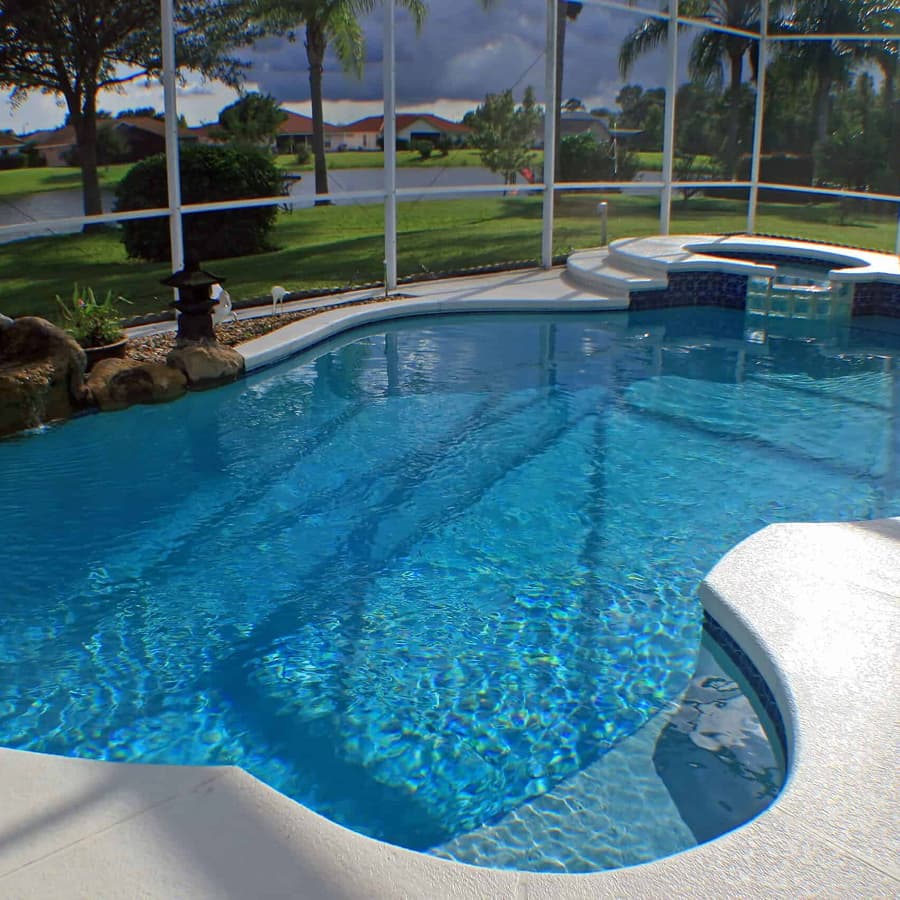
A pool that needs resurfacing usually announces itself in stages. Catching it early makes the project cheaper; ignoring it for too long lets the underlying shell start to suffer, which adds cost.
These are the seven signals Mark looks for during a pre-resurface walkthrough — and the three diagnostics worth running before scheduling, so you don't pay for a fix that lasts 3 years instead of 15.
The seven signals
1. Plaster chalking. Run your hand along the pool wall. If white powdery residue comes off, the plaster is breaking down. Chalking starts gradually around year 8 to 10 on a standard plaster finish; pebble finishes don't chalk this way.
2. Etched or rough texture. Surface that was smooth at install now feels rough underfoot or to the touch. Indicates either chemistry imbalance has eaten the surface, or the original plaster has reached normal end of life.
3. Visible staining that won't come off. Mineral stains (iron, copper, calcium) that resist normal cleaning are on the surface; staining that's deeper than the surface means the finish has lost its sealing capability.
4. Cracks or spider-web crazing. Hairline cracks across multiple panels indicate the plaster has shrunk and lost its bond to the shell. Localized cracks can sometimes be patched; system-wide crazing requires resurfacing.
5. Discolored patches that don't match the rest. Indicates uneven wear or chemistry damage. Often visible at the waterline, around skimmers and returns, and on the floor near the deepest end.
6. Calcium scaling at the waterline. Heavy white deposits along the waterline indicate water chemistry has been running high in calcium hardness for an extended period. The waterline tile may also need replacement if scaling has migrated under the tile edge.
7. Plaster age past lifespan. A pool resurfaced 15+ years ago is on borrowed time even if it looks acceptable. Standard plaster lifespan is 10 to 12 years; quartz is 12 to 18; pebble is 20 to 25.
If two or more of these signals are present, the pool is ready for resurfacing. If just one is present, the pool may have another 1 to 3 years before resurfacing becomes necessary.
The three diagnostics worth running first
Before scheduling resurfacing, run these checks. Otherwise the new finish may fail in 2 to 3 years for the same underlying reason the old one did.
Diagnostic 1 — Water chemistry history audit. Pull the last 12 months of test logs (most pool services keep them). Look for sustained out-of-range readings on calcium hardness (target 200 to 400 ppm), pH (target 7.4 to 7.6), or alkalinity (target 80 to 120 ppm). Sustained out-of-range chemistry shortens any finish's life and will do the same to a new one.
Diagnostic 2 — Shell crack inspection. With the water level dropped 6 to 12 inches, walk the perimeter and inspect the shell at the waterline. Hairline cracks in the plaster are normal; cracks in the underlying shell are not. Shell cracks need patching before resurfacing or the new finish will telegraph the same crack within months.
Diagnostic 3 — Equipment compatibility check. Inspect the equipment pad. Pre-2010 single-speed pumps are illegal in Florida for pumps over 1HP and should be replaced. Salt-water systems need compatible plumbing (some chlorine-era plumbing can't handle salt). Old heaters are inefficient compared to modern heat pumps. Resurfacing is the right time to upgrade — the pool is already drained.
Mark runs all three diagnostics on the Day-1 walkthrough.
What happens if you wait too long
A pool finish that's 3+ years past its useful life starts damaging the shell underneath. Three failure modes Mark sees most often:
Plaster delamination. The plaster loses its bond to the shell and starts coming off in sheets. Patching can buy time, but once delamination is widespread, the resurfacing project needs to include shell prep that wouldn't have been needed if caught earlier. Adds $1,500 to $4,000.
Pop-ups during low water level. A pool with weakened plaster and high groundwater pressure can have a section of the floor pop upward when drained for resurfacing. Repair adds $3,000 to $10,000 and 2 to 4 weeks.
Chemistry-driven shell etching. Sustained low pH or aggressive calcium hardness can etch into the actual shell beneath the plaster, requiring shell repair before any new finish goes on.
The discount for catching resurfacing at the right time vs. catching it 3 years late is typically $2,000 to $8,000.
When to delay
Sometimes the right answer is to wait. Two scenarios where delaying makes sense:
You're selling within 18 months. A resurface won't show up in the home's appraised value to the same degree it costs to install. Better to disclose the pool's condition and price the home accordingly than to spend $9,000 to $18,000 you won't recover.
The pool needs other work first. If the screen enclosure needs to be rebuilt or the deck needs major work, resurface those things in the right sequence. Resurface before deck work means the deck repair could damage the new finish.
Realistic timing
Plan ahead. The Florida pool resurfacing season is fall through early spring (October to March) when air temperature is mild for the chemistry cure. Summer resurfacing works but adds chemistry management complexity in the high heat.
Most NE Florida resurfacing contractors book 4 to 12 weeks out depending on time of year. Schedule the Day-1 walkthrough at least 2 months before you want the work done.
Related reading
- Pool Resurfacing Cost in Jacksonville, FL: 2026 Pricing by Finish — companion pricing piece
- Pool Resurfacing Cost & Permits in Northeast Florida — full guide
- Plaster vs Pebble vs Quartz Pool Finish: Which to Pick — finish-by-finish comparison
Ready when you are.
Tell me about your project — you'll see your real budget range mid-flow, and I'll call within 24 hours. No spam, no call center, just me.