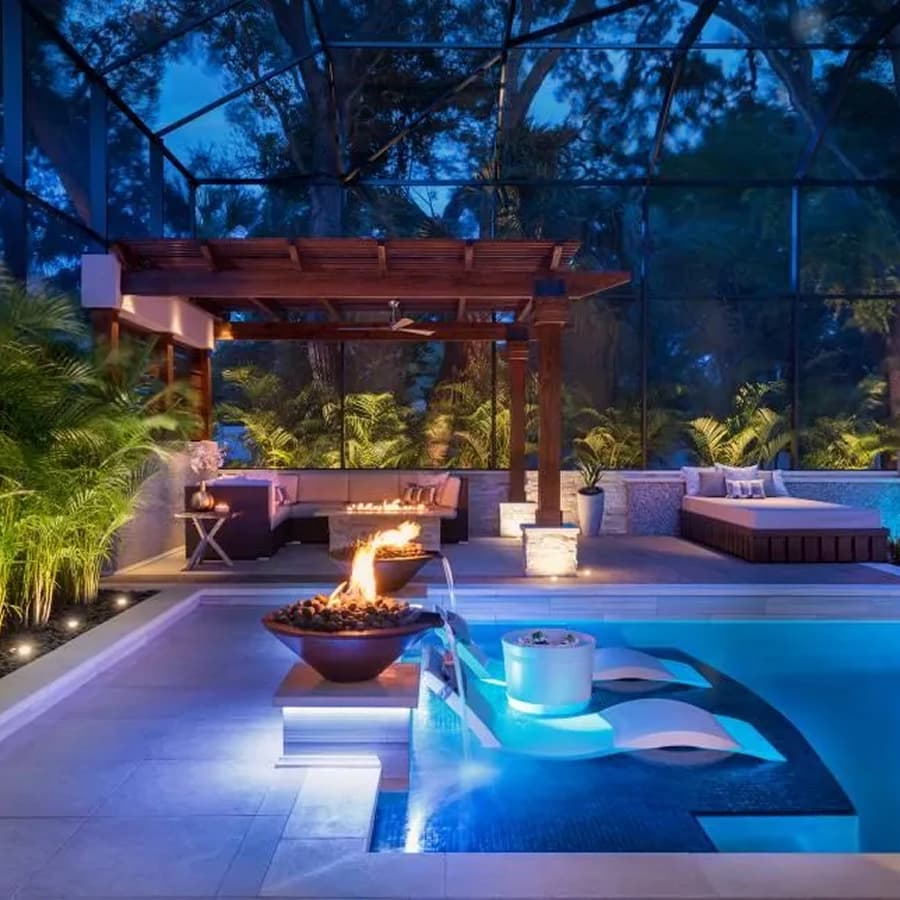
Three finish families dominate NE Florida pool resurfacing: standard plaster, quartz aggregate, and pebble. Each has a different lifespan, feel underfoot, color range, cost, and behavior with the local water chemistry. Picking the right one means thinking about how long you plan to keep the pool, how it'll be used, and what your water source has in it.
The three finishes side by side
| Finish | Cost (14×28 pool) | Lifespan | Feel | Color range | |---|---|---|---|---| | Plaster | $5,000–$9,000 | 10–12 years | Smoothest | Limited (white, gray, blue, sand) | | Quartz aggregate | $7,000–$13,000 | 12–18 years | Slightly textured | Medium (8–12 colors) | | Pebble (PebbleTec, PebbleSheen, Hydrazzo) | $9,000–$18,000 | 20–25 years | Pronounced texture | Wide (15+ colors) |
Plaster — when it's still the right call
Standard pool plaster is a mix of Portland cement, marble dust (or other aggregate), and water. It's the original pool finish and still the most common nationwide.
Choose plaster when:
- Budget is the primary constraint
- You're selling the home within 5 years and want the least-expensive renovation
- You prefer the smooth, traditional pool feel
- Your water chemistry is well-managed and stable
Skip plaster when:
- You're staying in the home long-term (cost-per-year math favors pebble)
- The pool sees heavy use (chemistry impact accelerates wear)
- Your local water has high mineral content that stains easily
NE Florida note: Standard plaster lifespan in NE Florida runs at the lower end of the national 10-15 year range because the climate (hot, humid) accelerates plaster wear. Plan on 10 to 12 years rather than 15.
Quartz aggregate — the middle option most people land on
Quartz aggregate is plaster with crushed quartz suspended in it. The quartz adds stain resistance, color depth, and a slight surface texture.
Choose quartz when:
- You want longer life than plaster without the pebble price
- You want broader color options than plaster (color matters for resale and aesthetics)
- The pool sees moderate use
- You're staying in the home 8 to 15 years
Skip quartz when:
- Budget allows for pebble (better long-term value)
- You want the smoothest possible surface (plaster wins on feel)
NE Florida note: Quartz performs well in NE Florida because the crushed quartz resists the iron and copper staining that often shows up in well water. It's the most common Mark spec's for Mandarin and Fleming Island remodels.
Pebble (PebbleTec, PebbleSheen, Hydrazzo) — the long-term winner
Pebble finishes use small smooth pebbles suspended in plaster, then exposed at the surface. PebbleTec is the brand that started the category; PebbleSheen and Hydrazzo are smoother variants. All three are similar enough to discuss together.
Choose pebble when:
- You're staying in the home 15+ years
- You want maximum slip resistance
- You want the longest-lasting finish available
- Premium aesthetic matters (pebble looks more custom and natural than plaster)
Skip pebble when:
- Budget genuinely doesn't support it
- The pool will see heavy use by users with sensitive feet (textured surface can be uncomfortable for some)
NE Florida note: Pebble is becoming the standard in Ponte Vedra and high-end Mandarin pools. The cost-per-year math favors it for any homeowner planning more than a decade in the house.
The chemistry compatibility check
This is the thing most resurfacing quotes don't address and that determines actual finish lifespan.
NE Florida water sources vary. JEA-supplied water, Clay County Utility Authority water, well water — each has different mineral content, pH stability, and treatment. Local water chemistry interacts with each finish differently:
Calcium hardness. All NE Florida water sources tend to run high in calcium. High calcium chronically pushes pH up and deposits scale on the finish. Plaster suffers most; quartz and pebble are more resistant.
Iron and copper. Well water in some Clay County and St. Johns areas runs high in iron. Iron stains plaster permanently within months of a chemistry imbalance; quartz and pebble are more resistant due to their aggregate composition.
Salt water. If you've converted to salt water (or are considering it), the salt accelerates plaster wear by 20 to 30%. Quartz and pebble both handle salt water better than plain plaster.
Mark's Day-1 walkthrough includes a water-source check. The right finish depends on what's coming out of the tap.
What the install difference looks like
Beyond the finish material itself, the application differs:
Plaster: Single-day pour by a trained crew. The plaster goes on wet, gets troweled smooth, and starts curing. Standard process.
Quartz: Same as plaster from an application standpoint. Slightly longer working time because of the aggregate.
Pebble: Wet application, then a wash-down step that exposes the pebbles at the surface. The wash-down timing is critical — too early washes out the pebbles, too late leaves them buried in plaster. Crew skill matters more on pebble than on standard plaster.
This is why finding a contractor with documented pebble experience matters. Tivey's RP252555575 license plus actual NE Florida pebble experience reduces the install-quality risk.
What's not in the cost comparison
All three finishes have similar surrounding costs that don't vary by material choice:
- Pool drain and protection setup: $400 to $800
- Old finish blast-off (sandblast or hydroblast): $1,500 to $3,000
- Tile band replacement (if needed): $1,500 to $3,500
- Bond coat application: included in finish cost
- Refill and start-up chemistry: $300 to $700
The finish material is roughly half the total resurfacing project cost; labor and ancillary work are the other half.
Related reading
- Pool Resurfacing Cost in Jacksonville, FL: 2026 Pricing by Finish — pricing by tier
- When to Resurface Your Florida Pool — timing decisions
- Pool Resurfacing Cost & Permits in Northeast Florida — full guide
Ready when you are.
Tell me about your project — you'll see your real budget range mid-flow, and I'll call within 24 hours. No spam, no call center, just me.